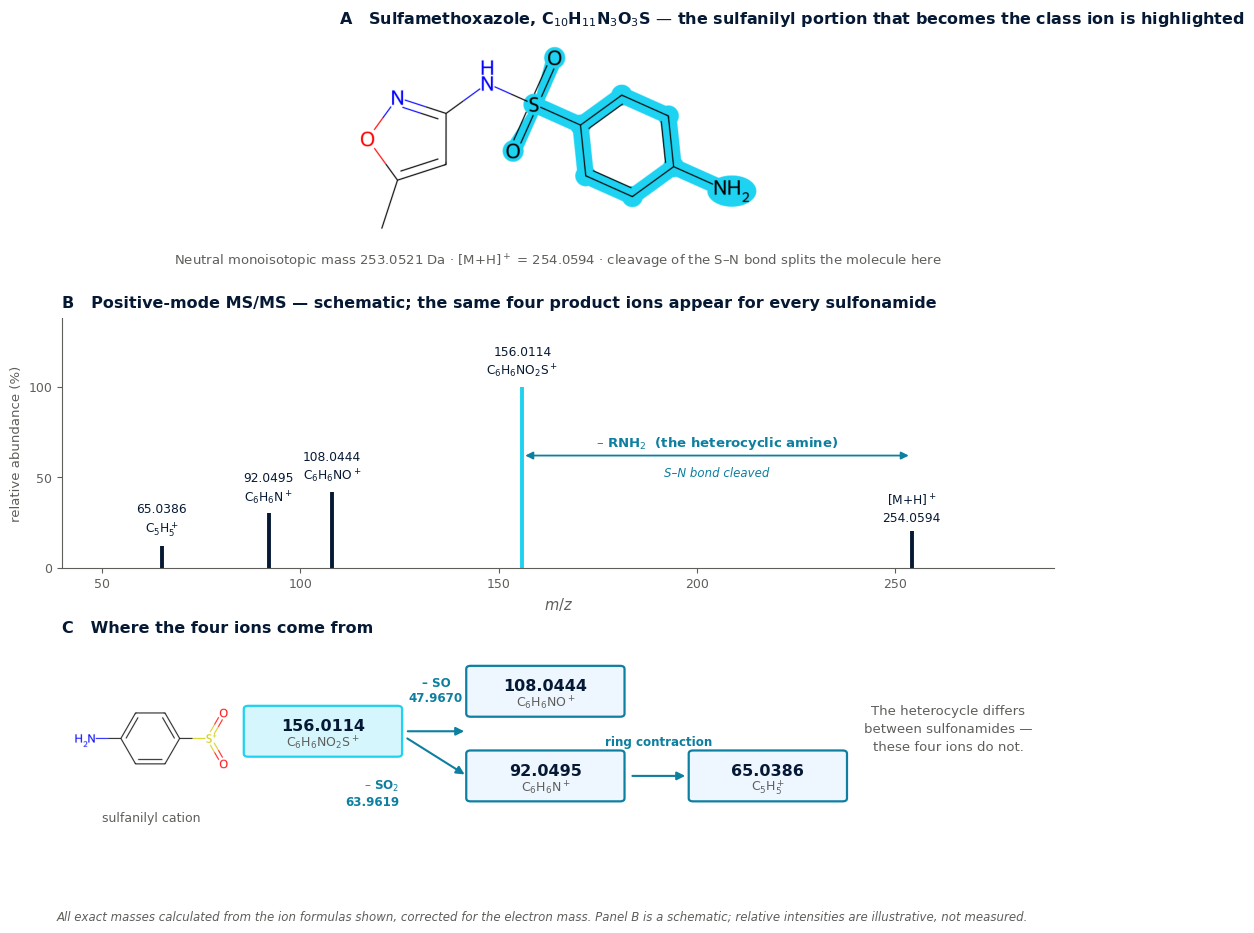
Every sulfonamide fragments to the same handful of ions, regardless of the heterocycle attached to it. That makes the class one of the easiest to recognise in an unknown spectrum — and one of the most useful for class-wide screening. This is a reference page: the diagnostic ions, their exact masses, their assignments, and the one isobaric trap that catches people out.
The class signature. In positive ESI, protonated sulfonamides give m/z 156.0114 almost without exception, followed by 108.0444, 92.0495 and 65.0386. The most useful neutral loss is 93.0578 Da (aniline). Seeing 156 plus any two of the others is strong evidence for a sulfonamide.

Diagnostic product ions
| Nominal m/z | Exact m/z | Ion formula | Assignment | Diagnostic value |
|---|---|---|---|---|
| 156 | 156.0114 | C6H6NO2S+ | [M+H−RNH2]+ — sulfanilyl cation, from cleavage of the S–N bond | Highest — occurs in essentially every sulfonamide |
| 108 | 108.0444 | C6H6NO+ | [M+H−RNH2−SO]+ | High — common confirming ion |
| 92 | 92.0495 | C6H6N+ | [M+H−RNH2−SO2]+ — anilinium-type structure | High — common confirming ion |
| 65 | 65.0386 | C5H5+ | Ring contraction after full loss of the sulfonyl and amine functions | Moderate — needs high collision energy |
| varies | — | — | [M+H−155]+ — the complementary ion carrying the amine substituent | Compound-specific — identifies which sulfonamide |
The ion at m/z 156 arises from cleavage of the sulfur–nitrogen bond and is described in the literature as the fragment obtained for all sulfonamides and therefore of the highest diagnostic value (Peer-reviewed evidence). Its accurate mass of 156.0114 can be used directly to scan for further sulfa drugs and their metabolites (Peer-reviewed evidence).
Diagnostic neutral losses
| Nominal loss | Exact loss (Da) | Neutral lost | Where it occurs |
|---|---|---|---|
| 93 | 93.0578 | C6H7N (aniline) | Second most common pathway; dissociation at the S–C bond with proton transfer |
| 66 | 65.9775 | H2SO2 | Competing rearrangement |
| 48 | 47.9670 | SO | 156 → 108 |
| 64 | 63.9619 | SO2 | 156 → 92 |
The isobaric trap at m/z 156
Sulfadimethoxine produces a second ion at nominal m/z 156 — the other half of the molecule, at accurate mass 156.0768 (C6H10N3O2+) (Peer-reviewed evidence). The two differ by 65.4 mDa, or about 420 ppm.
On a triple quadrupole set to unit resolution these are the same peak, and a class filter on “156” will fire on both. On any high-resolution instrument they separate easily. If you build a class-screening method around m/z 156, specify the exact mass.
A second practical note on labelled standards: 13C-labelled sulfonamide standards do not fragment to m/z 156 but to m/z 162, because the labels sit in the aniline ring (Peer-reviewed evidence). A method that monitors only 156 will not see its own internal standard.
Documented transitions for individual sulfonamides
Precursor and product ions from a published multi-residue method. The pattern is the point: the precursor differs, the products do not.
| Compound | Precursor [M+H]+ | Quantifier | Qualifier |
|---|---|---|---|
| Sulfacetamide | 215.2 | 156 | 108 |
| Sulfadiazine | 251.3 | 156 | 92 |
| Sulfathiazole | 256.0 | 156.1 | 65.2 |
(Peer-reviewed evidence — manufacturer application note, nominal masses as published.) For a full multi-residue panel, consult the source method rather than transferring these values blindly; collision energies are instrument-specific.
How to use this in practice
- Class screening. A precursor-ion scan for m/z 156.0114 finds sulfonamides across a sample without a target list. Reported as a working approach for detecting all members of the class in one scan (Peer-reviewed evidence).
- Identifying the individual compound. The class ions tell you it is a sulfonamide. The complementary [M+H−155]+ ion, carrying the amine substituent, tells you which one.
- Collision energy. 156 appears at low to moderate energy; 92 and especially 65 need more. Acquire at two energies if you want the full set. (Practical starting point)
- Negative mode is used for some sulfonamides but the class-diagnostic ions above are positive-mode fragments.
Limits
These ions identify the sulfanilamide core. They say nothing about the heterocyclic substituent, which is what distinguishes sulfamethoxazole from sulfadiazine from sulfadimethoxine — that requires the precursor mass, the complementary fragment, and chromatographic separation against standards. Acetylated and hydroxylated metabolites retain the core and therefore still give m/z 156, which is useful for finding them and useless for telling them apart.
References
- Novel Ion Trap Scan Modes to Develop Criteria for On-Site Detection of Sulfonamide Antibiotics. Analytical Chemistry 2021;93(41):13904 — source for m/z 156 as the fragment of highest diagnostic value across the class, the neutral loss of 93 Da as the second most common pathway, the competing H2SO2 loss, and the m/z 162 behaviour of labelled standards. Article page
- Analysis of Pharmaceuticals in Environmental Samples with Ultrahigh-Definition LC–QTOF-MS and Accurate Mass. LCGC International — source for the accurate mass 156.0114 as a family diagnostic ion and for the isobaric ion at 156.0768. Article
- Simultaneous determination of 31 sulfonamide residues in various livestock matrices using LC-MS/MS. Applied Biological Chemistry 2024 — source for the assignments of m/z 156, 108 and 92 to [M+H−RNH2]+, [M+H−RNH2−SO]+ and [M+H−RNH2−SO2]+. doi:10.1186/s13765-024-00864-z
- Determination of sulfonamide drugs using Bond Elut HLB — MRM transitions for individual sulfonamides. Agilent application note 5994-6896EN. agilent.com (PDF)
Exact m/z values in the tables and in Figure 1 were calculated from the ion formulas given, using standard atomic masses and correcting for the electron mass, and can be reproduced independently. The structure in Figure 1 was generated from SMILES and its molecular formula verified computationally. Reference 1 predates this series’ usual reference window and is cited for the class fragmentation behaviour, which is not time-dependent.
Leave a Reply