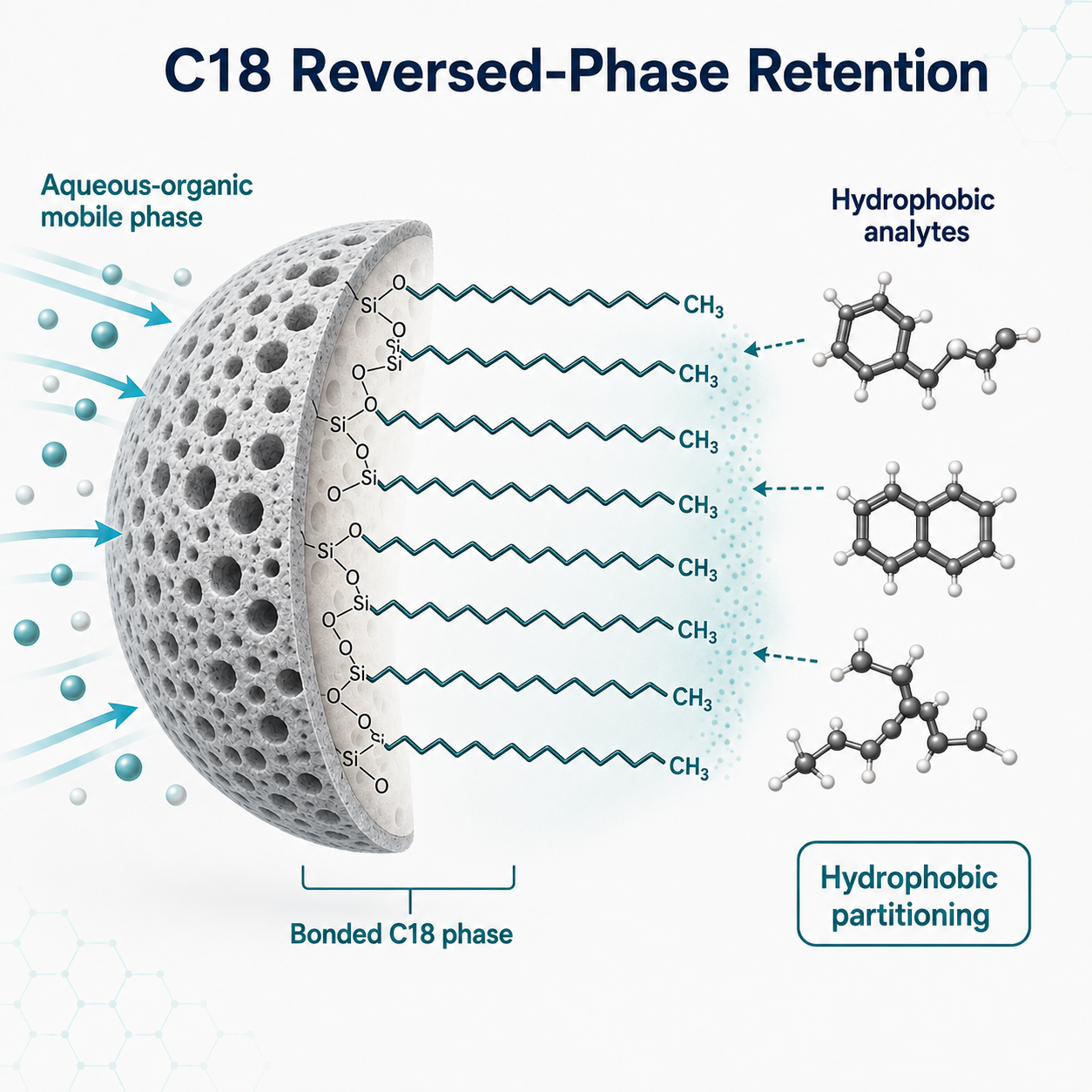

The C18 column is the most widely used stationary phase in all of liquid chromatography — the default starting point in pharmaceutical, environmental, clinical and food laboratories worldwide. But “C18” is not one product; it is a whole family of columns from many manufacturers, and the best choice depends heavily on your matrix and application. This guide looks at which C18 columns actually appear in the recent (2025–2026) literature, organised by what they are used for, with links to real published methods.
If you are new to reversed-phase separations, our guide on how to choose the right HPLC column covers the fundamentals behind the choices below.
Why C18 dominates — and why a list needs context
A 2026 review in Discover Chemistry confirms that reversed-phase HPLC with C18 columns is the dominant method in pharmaceutical laboratories, valued for its versatility, robustness and effectiveness across a broad range of drug substances [1]. The strong hydrophobic retention of the octadecyl (C18) chain, combined with excellent reproducibility and wide availability, is what makes it the universal default.
An honest caveat, as with any “most used” list: there is no single public database ranking C18 columns by exact usage count, and any specific number would be false precision. What follows instead is grounded in which columns recur in current peer-reviewed methods, grouped by application — because the right C18 for trace PFAS in water is not the same as the right C18 for a routine tablet assay.
1. Pharmaceutical analysis (assay, purity, stability)
This is the largest application area and the reason C18 became the standard. Typical configurations are 150–250 mm × 4.6 mm with 3–5 µm particles for routine QC, moving to sub-2 µm for faster UHPLC methods.
Columns that recur: Agilent ZORBAX (Eclipse Plus, SB-C18, XDB), Waters Symmetry/XBridge/XSelect, Phenomenex Luna and Kinetex, Thermo Hypersil GOLD.
- Example (2025): paracetamol and camylofin in human serum were separated on an Agilent Zorbax XDB C18 column (50 × 2.1 mm, 5 µm) with a Phenomenex guard column — a compact, fast QC-style setup [2].
- Analytes/matrix: APIs, impurities and degradation products in tablets, capsules and biological serum.
For the practical side of setting up these methods — buffers, pH and organic modifiers — see our mobile phase basics guide.
2. Bioanalysis (plasma, serum, tissue; PK/TDM)
Quantifying drugs in biological fluids demands high sensitivity and clean separations from a complex matrix, almost always by LC-MS/MS after protein precipitation. Short, small-ID, sub-2–3 µm or core-shell C18 columns dominate here for speed and low detection limits.
Columns that recur: Agilent Poroshell 120 EC-C18, Thermo Hypersil GOLD, ACE (BEH) C18, Phenomenex Synergi Fusion-RP, Waters XTerra/BEH.
- Example (2025): amoxicillin and clavulanate in human plasma were quantified on a Poroshell 120 EC-C18 column in a 6.5-minute LC-MS/MS run [3].
- Example (2026): the EGFR inhibitor pelitinib was quantified across plasma and liver microsomes on an Agilent Eclipse Plus C18 column [4].
- Analytes/matrix: small-molecule drugs and metabolites in plasma, serum, and tissue homogenates for pharmacokinetics and therapeutic drug monitoring.
3. Environmental analysis (water, soil; PFAS, pesticides)
Environmental trace analysis — especially PFAS — is one of the fastest-moving areas, and it has driven the development of dedicated C18 chemistries. Here the challenge is retaining highly polar analytes and, critically, using a delay column to separate PFAS background contamination from the instrument itself.
Columns that recur: Waters ACQUITY Premier BEH C18 and Atlantis Premier BEH C18 AX (mixed-mode), Agilent Altura Poroshell 120 PFAS, GL Sciences InertSustain AQ-C18, and general superficially-porous C18 phases.
- Example (2026): simultaneous C1–C18 PFAS in drinking water by large-volume direct injection on an Agilent Altura Poroshell 120 PFAS column with a dedicated delay column [5].
- Example (2026): a review of PFAS across matrices highlights superficially porous, ethane-crosslinked C18 columns paired with high-pH ammonia mobile phases [6].
- Analytes/matrix: legacy and ultra-short-chain PFAS, pesticides and surfactants in drinking water, wastewater, soil and sediment. The EPA 1633 method itself specifies a reversed-phase C18 column plus an analytical delay column.
4. Food and beverage analysis (mycotoxins, vitamins, additives)
Food matrices are chemically complex, so robustness and clean separation matter most. Core-shell C18 columns have become especially popular here for their efficiency at moderate pressure.
Columns that recur: Phenomenex Kinetex C18 (and XB-C18), Agilent Poroshell, Phenomenex Luna C18, Merck Chromolith RP-18e (monolithic).
- Example: multi-mycotoxin analysis in wheat flour found a Phenomenex Kinetex XB-C18 core-shell column gave better separation efficiency and sensitivity than a competing monolithic RP-18 column [7].
- Analytes/matrix: aflatoxins, ochratoxin, DON and other mycotoxins, plus vitamins, additives and contaminants in grains, feed and beverages.
The most-recurring C18 column families
Pulling the applications together, a handful of C18 lines appear again and again across the 2025–2026 literature. Grouped by manufacturer, with links to their pages:
- Agilent — Poroshell 120 (EC-C18, core-shell) and the ZORBAX family (Eclipse Plus, SB-C18, XDB). Strong in bioanalysis and pharma.
- Waters — ACQUITY Premier BEH C18 and Atlantis/Symmetry/XBridge. Dominant in PFAS and regulated methods.
- Phenomenex — Kinetex C18 (core-shell) and Luna C18. Widely used in food and general-purpose work.
- Thermo Fisher — Hypersil GOLD C18 and Accucore. Common in bioanalysis and routine LC-MS.
How to choose your C18 by application
- Routine pharma QC → a robust, fully porous 5 µm C18 (ZORBAX, Luna, Symmetry) in a 150 × 4.6 mm format.
- Bioanalysis / PK / TDM → a short, small-ID core-shell or sub-2 µm C18 (Poroshell EC-C18, Hypersil GOLD) for speed and sensitivity.
- PFAS / environmental → a dedicated PFAS or high-pH-stable C18 (Altura Poroshell PFAS, ACQUITY Premier BEH C18) with a delay column.
- Food / complex matrices → a rugged core-shell C18 (Kinetex, Poroshell) that tolerates dirty samples.
In every case, a guard column extends the life of the analytical column — essential for the messy matrices in bioanalysis, environmental and food work.
Key takeaways
- C18 is the universal default, but the best column depends on your matrix and application, not brand alone.
- Pharma QC favours robust fully porous 5 µm phases; bioanalysis favours short core-shell/sub-2 µm columns.
- PFAS/environmental work needs dedicated PFAS or high-pH C18 phases with a delay column.
- Food analysis leans on rugged core-shell C18 columns for complex matrices.
- The recurring families in current literature are Agilent Poroshell/ZORBAX, Waters BEH, Phenomenex Kinetex/Luna and Thermo Hypersil GOLD.
References
- Review of reversed-phase HPLC in pharmaceutical analysis. Discover Chemistry. 2026. doi:10.1007/s44371-026-00640-6
- Simultaneous determination of paracetamol and camylofin in human serum. Future Journal of Pharmaceutical Sciences. 2025. doi:10.1186/s43094-025-00886-4
- LC-MS/MS quantification of amoxicillin and clavulanate in human plasma. 2025. Open-access article (PMC12300523)
- Quantification of the EGFR inhibitor pelitinib in plasma and liver microsomes. Journal of Pharmaceutical and Biomedical Analysis. 2026. Article page
- Simultaneous analysis of C1–C18 PFAS in drinking water by large-volume direct injection. 2026. Application note
- Modern PFAS analysis: new analytical options for testing PFAS in various matrices. LCGC International. 2026. Article
- Comparison of core-shell and monolithic reversed-phase columns for multi-mycotoxin analysis in wheat flour. Open-access article (PMC7393054)
Leave a Reply