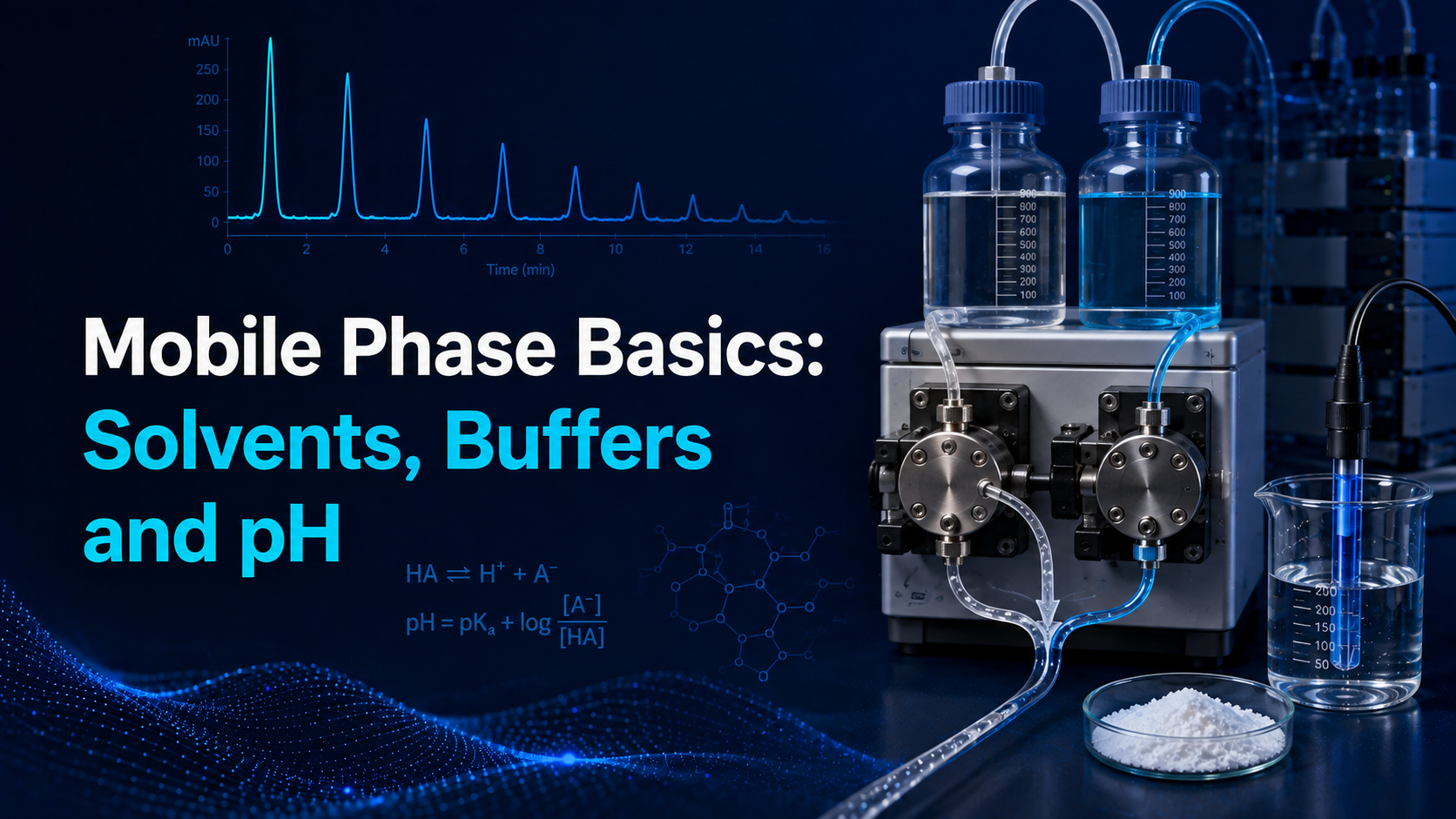
The mobile phase is the liquid that carries your sample through an HPLC column — and it does far more than just “push things along.” Its composition directly controls how your compounds separate, how sharp your peaks are, and how reproducible your results will be. For beginners, getting comfortable with mobile phase basics is one of the best investments you can make. This guide covers the essentials: solvents, buffers and pH.
What is the mobile phase?
In liquid chromatography, the mobile phase is the solvent (or blend of solvents) that flows continuously through the system, transporting your sample across the stationary phase inside the column. Where the stationary phase holds compounds back, the mobile phase moves them forward — and the balance between these two forces is what produces a separation. The combination of stationary-phase chemistry and mobile-phase composition is what determines the separating power of a method [1].
Because the mobile phase interacts with every compound in your sample, small changes to it can have a big effect on your results. This makes it both a powerful tool and something you need to prepare carefully.
Common solvents
In reversed-phase HPLC — the most common mode — the mobile phase is usually a mixture of water with one or more organic solvents. The two organic solvents you will meet most often are:
- Acetonitrile (ACN). A very popular choice thanks to its low viscosity (meaning lower back-pressure) and good compatibility with UV detection. It is often the default organic solvent in method development.
- Methanol (MeOH). Cheaper than acetonitrile and offers slightly different selectivity, which can help separate compounds that acetonitrile struggles with. It is more viscous, so it generates higher pressure.
The water component is just as important and should always be of high purity (HPLC-grade or purified in-house), because impurities in water can create ghost peaks and baseline problems. For LC-MS work, use solvents and additives that are explicitly specified as LC-MS grade [2].
Isocratic vs. gradient
There are two ways to run the mobile phase, and knowing the difference is essential:
- Isocratic. The mobile phase composition stays constant throughout the run — for example, a fixed 60% water / 40% acetonitrile. Simple, reproducible and easy to set up, but less effective for samples containing compounds with very different properties.
- Gradient. The composition changes during the run — typically starting with more water and gradually increasing the organic solvent. This “washes out” strongly retained compounds more efficiently and is ideal for complex mixtures. It is more powerful but also more demanding on the equipment and slightly harder to reproduce.
As a beginner, isocratic runs are a great place to start because they are so straightforward. Gradients become important as your samples get more complex.
The role of buffers and pH
Many compounds — especially acids and bases — can gain or lose an electrical charge depending on the pH of their surroundings. This matters enormously in HPLC, because a charged molecule behaves very differently from a neutral one and will have a different retention time.
The problem is that if the pH is not controlled, tiny variations can cause peaks to shift, broaden or split, making your results inconsistent. The solution is a buffer: a chemical system that holds the pH steady even when small amounts of acid or base are present. A buffer works best when its pKa lies close to the working pH, which is why buffer choice and target pH have to be decided together [3].
Common buffers in HPLC include phosphate and acetate systems, along with additives like formic acid or ammonium formate (the latter being popular when the method is coupled to mass spectrometry). Volatile ammonium salts are used for LC-MS because nonvolatile salts such as phosphate contaminate the ion source and suppress the signal [3]. Our step-by-step guide to preparing an HPLC buffer works through the calculation and the practical procedure.
Beyond simply fixing the pH, acids and bases can change selectivity in their own right — sometimes dramatically. Published examples are collected in our article on how acids and bases improve HPLC in complex matrices.
Practical mobile phase tips
- Use high-purity solvents and water. Impurities are a leading cause of ghost peaks and noisy baselines [2].
- Filter and degas. Filtering removes particulates that can clog the system; degassing removes dissolved air that can form bubbles and disrupt the flow. For UHPLC, use a finer filter membrane than for conventional HPLC [4].
- Prepare buffers fresh. Buffer solutions can grow microbes over time, especially those containing phosphate. Make them fresh and do not top up an old bottle [4].
- Watch buffer compatibility. High concentrations of some buffers can precipitate when mixed with a lot of organic solvent, potentially blocking the system. Check solubility limits across the whole gradient [3].
- Rinse after buffer use. Flush buffer out of the system with water (and then organic solvent) at the end of the day to prevent salt deposits and corrosion [3].
Key takeaways
- The mobile phase controls separation, peak shape and reproducibility — not just transport.
- Acetonitrile and methanol are the most common organic solvents, mixed with high-purity water.
- Isocratic runs keep composition constant; gradient runs change it over time for complex samples.
- Buffers control pH, which keeps ionisable compounds behaving consistently.
- Filtering, degassing and rinsing are simple habits that prevent many common problems.
References
This is an introductory article. The sources below are freely accessible manufacturer primers and technical guides covering the points described above.
- HPLC Column Hardware — how stationary phase and mobile-phase composition together determine separating power. Waters. waters.com
- Controlling contamination in LC-MS systems — solvent purity, background signals and their sources. Waters. waters.com (PDF)
- Mobile-phase and buffer reference chart — buffer systems, pKa ranges, solubility and volatility for LC and LC-MS. Waters. waters.com (PDF)
- HILIC column care guide — filtration recommendations (0.2 µm, 0.1 µm for UHPLC) and the warning against topping up old buffer. Thermo Fisher Scientific. thermofisher.com (PDF)
- Agilent technical overview on mobile-phase control and column lifetime. agilent.com (PDF)
Leave a Reply