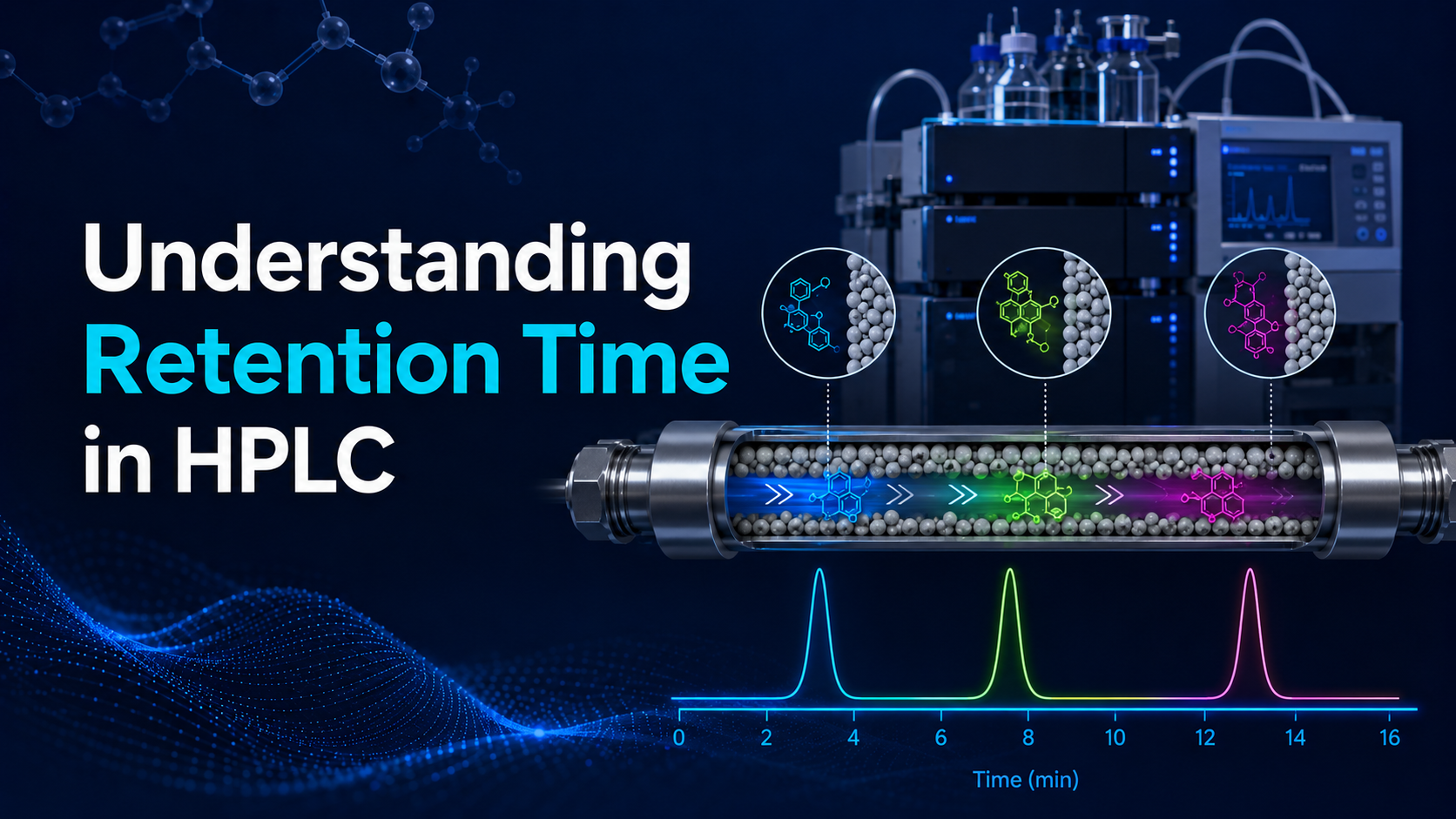
If you look at any HPLC chromatogram, the first thing you notice is a series of peaks spread out along a time axis. The position of each peak — when it appears — is called its retention time. It is one of the most fundamental concepts in liquid chromatography, and getting comfortable with it early will make everything else easier to understand. This guide explains what retention time is, why it matters, and what makes it change.
What is retention time?
Retention time is simply how long a compound takes to travel from the moment of injection to the moment it is detected at the end of the column. It is usually measured in minutes and marked at the top of each peak [1].
Because different compounds interact with the stationary phase to different degrees, they move through the column at different speeds — and therefore come out at different times. A compound that barely interacts elutes quickly (short retention time); one that interacts strongly is held back (long retention time). This spreading-out in time is exactly what gives you a separation [2].
Why retention time matters
Retention time is valuable for one main reason: under identical conditions, a given compound always elutes at roughly the same time. This makes it a fingerprint you can use for identification [1].
In practice, you run a known reference standard and note its retention time. When you then run an unknown sample and see a peak at the same retention time, that is strong evidence the same compound is present. It is not absolute proof on its own — two different compounds can occasionally share a retention time — but it is a powerful and everyday tool for identification.
The dead time (void time)
There is a small but important detail: even a compound that does not interact with the column at all still takes some time to travel through, simply because it is carried along by the mobile phase. This minimum travel time is called the dead time or void time (often written as t0).
Nothing can elute faster than the dead time. Understanding this helps you interpret early peaks: a peak right at the dead time usually represents unretained material, not a genuinely separated compound.
What affects retention time?
Retention time is sensitive to your conditions. If any of the following change, your retention times will shift — which is why reproducibility matters so much in HPLC.
- Mobile phase composition. This is the biggest lever. In reversed-phase HPLC, increasing the proportion of organic solvent (like methanol or acetonitrile) makes compounds elute faster, shortening retention times [2].
- Flow rate. A higher flow rate pushes everything through more quickly, reducing retention times (though it also raises back-pressure).
- Column temperature. Higher temperatures generally reduce retention times and can also change how well compounds separate.
- Column age and condition. As a column ages or becomes contaminated, retention times can drift — a useful early warning sign that something is changing [3].
- pH of the mobile phase. For compounds that can gain or lose charge, small pH changes can cause large shifts in retention. How to prepare and control that pH is covered in our guide to preparing an HPLC buffer.
Retention time vs. retention factor
Because retention time depends on flow rate and column dimensions, it is not always ideal for comparing results between different systems. For that, chromatographers use a related, more universal value called the retention factor (k), which compares how long a compound is retained relative to the dead time [2].
You do not need to master the maths as a beginner, but it is worth knowing the idea exists: the retention factor lets people compare separations fairly even when the exact instruments differ. A good rule of thumb is that useful separations usually have retention factors somewhere between about 2 and 10 — peaks that elute too early or far too late are harder to work with.
Troubleshooting shifting retention times
When retention times start to drift from run to run, it is almost always a sign of a condition that is not stable. Common culprits include:
- An inconsistent or poorly mixed mobile phase.
- Temperature fluctuations (a good reason to use a column oven).
- A failing pump or air bubbles affecting the flow rate.
- A column reaching the end of its life [3].
Because retention time reacts to all of these, it is one of the most useful diagnostic signals you have — a shift is often the first clue that something needs attention. In HILIC the same symptom has an additional and very common cause: insufficient re-equilibration, because the water layer at the surface has not reformed. That case is covered in our article on how HILIC retention works.
Key takeaways
- Retention time is how long a compound takes to pass through the column and reach the detector.
- Under identical conditions it is reproducible, making it useful for identification.
- The dead time is the minimum possible travel time for unretained material.
- Retention time is affected by mobile phase, flow rate, temperature, pH and column condition.
- Drifting retention times are a valuable early warning that conditions are not stable.
References
This is an introductory article. The sources below are freely accessible manufacturer primers and technical guides covering the concepts described above.
- Identifying and Quantitating Compounds Using HPLC — retention time as the basis for identification, peak area for quantitation. Waters. waters.com
- HPLC Column Hardware — how stationary phase and mobile-phase composition together determine retention and resolution. Waters. waters.com
- Agilent technical overview on mobile-phase control and column lifetime — how mobile-phase conditions and column ageing affect retention stability. agilent.com (PDF)
- Beginner’s Guide to High-Performance Liquid Chromatography (HPLC) — general background on the technique. Waters. waters.com
Leave a Reply