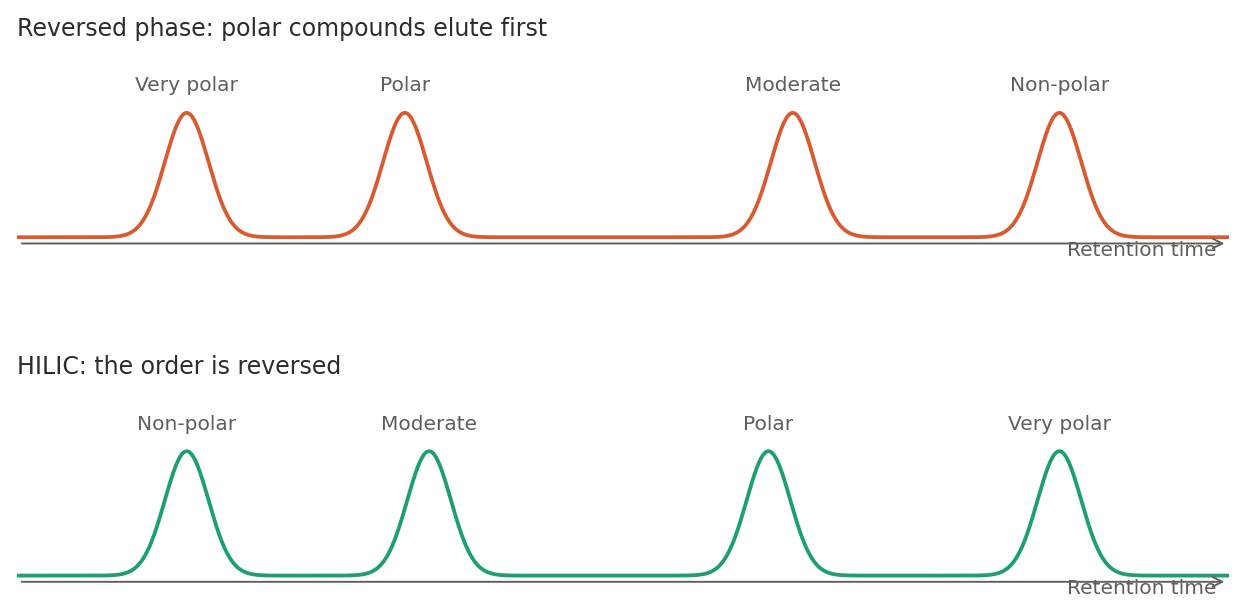
HILIC is often introduced as reversed-phase chromatography run backwards. That description is convenient, and it is the reason many HILIC methods fail. Retention in hydrophilic interaction liquid chromatography is not one process but several acting at once, and the balance between them shifts with the stationary phase, the buffer, the pH and even the analyte’s charge state. When a HILIC method drifts, tails or loses retention overnight, the cause is almost always that a different mechanism has taken over than the one you designed for.

Quick answer
Four mechanisms carry HILIC retention, plus one that decides how the whole method behaves:
- Hydrophilic partitioning into the water layer adsorbed on the polar surface
- Hydrogen bonding to hydroxyl, amide, urea or similar surface groups
- Surface adsorption directly onto the stationary phase
- Electrostatic interaction between charged analytes and charged surface sites
- Solvent and buffer conditions, which determine which of the four dominates
A 2026 review of the fundamental research on HILIC concludes that the adsorbed water layer acts as the de facto stationary phase for hydrophilic partitioning, and that molecular dynamics simulation together with quantitative phase-ratio measurement has clarified how that layer forms and behaves. The same review reports that newer theoretical and experimental approaches now dissect the contributions of partitioning, surface adsorption and electrostatic interactions for individual solutes and systems, rather than treating one mechanism as universally dominant [1].
Mechanism 1: hydrophilic partitioning

In a mobile phase containing a high proportion of acetonitrile, water preferentially accumulates at the polar surface of the packing. This water-enriched layer is not bulk mobile phase and not simply bound surface water — it behaves as a separate liquid phase. Polar analytes distribute between the organic-rich bulk and that layer, exactly as a solute distributes between two immiscible solvents.
Two consequences follow directly. Retention increases as the acetonitrile fraction rises, because the phase ratio and the driving force for partitioning both increase. And an aqueous sample plug is a strong solvent in HILIC: injecting an analyte dissolved in water floods the layer it is supposed to partition into, which produces fronting, splitting or complete breakthrough.
Starting conditions, gradients and equilibration are covered in our guide to developing a HILIC method.
Mechanism 2: hydrogen bonding

Partitioning alone cannot explain why an amide phase, a diol phase and bare silica give different elution orders for the same mixture at identical mobile-phase composition. Surface chemistry contributes directionally: hydroxyl, amide and urea groups form hydrogen bonds with analyte donors and acceptors, and the strength depends on the geometry of both partners.
This is why carbohydrates behave so distinctly on amide phases, and why swapping one HILIC column for another of a different chemistry is a change of method rather than a change of hardware. Selectivity differences between HILIC chemistries are usually larger than between two C18 columns.
Mechanism 3: surface adsorption

Some analytes do not dissolve into the water layer at all; they adsorb onto the surface itself. Quantitative work on HILIC retention has shown that partitioning and adsorption represent two ends of a spectrum, and that which one dominates depends on the individual compound rather than on the column alone [3].
The practical signature of an adsorption-dominated retention is a mismatch between how you expect retention to scale with acetonitrile and how it actually does. If retention responds far more weakly to solvent composition than expected for a partitioning process, adsorption is probably carrying the separation — and the correct lever is then the surface chemistry or the buffer, not the gradient.
Mechanism 4: electrostatic interaction

Once the analyte or the surface carries a charge, the picture changes fundamentally. Dissociated silanols retain cations by ion exchange; amine-functionalised phases retain anions. The interaction adds to hydrophilic retention, but it does not respond to solvent composition in the same way — it responds to ionic strength and pH.
A 2025 characterisation study of five HILIC columns illustrates how large these differences are between materials that are all nominally “zwitterionic”. Using the Tanaka test protocol, the authors found that cation-exchange character increased with buffer pH on several columns, which they attributed to dissociation of unprotected silanols, and that the effect was much weaker at 25 mM buffer because higher ionic strength suppresses the electrostatic attraction. One column, Atlantis Premier BEH Z-HILIC, showed no cation-exchange character yet the highest overall retentivity of the set, meaning its retention comes from other interactions entirely [4].

That last point deserves emphasis: two zwitterionic columns are not interchangeable. Their mechanism mix differs, so a method transferred between them can change elution order, not just retention time.
Mechanism 5: the mobile phase decides which of the others wins
Solvent fraction, buffer concentration and pH are not three settings that fine-tune one mechanism. They select between mechanisms. Work published in 2025 examined the independent effects of individual mobile-phase components on the retention mechanism of ionisable analytes in HILIC, reinforcing that these variables act separately rather than as a single “eluent strength” parameter [2].
| Variable | Primarily affects | What you see when you change it |
|---|---|---|
| Acetonitrile fraction | Partitioning | Retention rises steeply as organic content increases; strong effect on neutral polar analytes |
| Buffer concentration | Electrostatics | Retention of charged analytes falls when attraction is shielded, or rises when repulsion is shielded |
| pH | Charge state of analyte and surface | Elution order can change, not just spacing |
| Buffer identity | Ionic environment and MS response | Selectivity shifts; formate and acetate are not equivalent |
| Temperature | All of the above, weakly | Small selectivity changes; useful only after the others are fixed |
Troubleshooting by mechanism
| Symptom | Probable cause | Diagnostic check | Corrective action |
|---|---|---|---|
| Analytes elute at the void | Too little acetonitrile, or sample solvent too aqueous | Reinject the same sample diluted 1:5 in acetonitrile | Raise initial organic content; reconstitute in the initial mobile phase |
| Peak fronting or splitting for early peaks only | Injection solvent mismatch, not column failure | Reduce injection volume fivefold | Match sample solvent to initial mobile phase; reduce volume |
| Severe tailing of basic analytes | Cation exchange on dissociated silanols | Repeat at higher buffer concentration | Increase ionic strength; lower pH; consider a phase with lower silanol activity |
| Retention drifts across a sequence | Water layer not equilibrated, or matrix conditioning the surface | Inject a standard repeatedly and plot retention against injection number | Increase re-equilibration substantially; add a compatible wash step |
| Retention barely responds to organic content | Adsorption or electrostatics dominate, not partitioning | Run a short solvent series at constant buffer | Change surface chemistry or ionic strength instead of the gradient |
| Elution order changes after a buffer change | Charge state of analyte or surface has shifted | Compare pH of both eluent batches, measured the same way | Fix and document pH measurement procedure; re-verify order |
| Method fails after transfer to another zwitterionic column | Different ion-exchange character between materials | Run a cation and an anion probe on both columns | Re-optimise buffer and pH for the new material |
Worked scenario: the method that only fails on real samples
A quantitative HILIC-MS/MS method for a basic metabolite passes with standards: symmetrical peak, retention factor around 4, replicate injections within 0.3% RSD. In extracted plasma the peak tails badly and retention drifts earlier across the batch.
The diagnostic sequence separates the mechanisms rather than guessing:
- Rule out the injection solvent. Dilute an extract 1:5 in acetonitrile and reinject. If tailing improves, the aqueous plug was overwhelming the water layer.
- Test the electrostatic contribution. Repeat the extract at 10 mM and at 20 mM buffer, holding pH and gradient constant. If tailing falls at the higher concentration, cation exchange with charged surface sites is involved and matrix ions are competing for those sites.
- Test the partitioning contribution. Raise the initial acetonitrile by five percentage points. If retention increases as expected, partitioning is intact and the problem is confined to the ionic interaction.
- Test equilibration. Double the re-equilibration volume for one sequence. If the retention drift disappears, the water layer was not reforming between injections at the previous setting.
Each step changes exactly one variable and rules a mechanism in or out. The common failure is to change buffer, gradient and injection volume at once, get a better chromatogram and never learn which factor mattered — leaving the method just as fragile as before.
Practical starting conditions
(Practical starting point — screening conditions only, not a validated method)
- Initial composition around 90% acetonitrile, gradient to 60% over 12–15 minutes
- Volatile ammonium formate or acetate buffer for LC-MS; screen both a lower and a higher concentration rather than fixing one
- Screen at least one acidic and one near-neutral pH; use alkaline conditions only on a column rated for them
- Sample dissolved in the initial mobile phase, injection volume around 1% of the column volume
- Re-equilibration according to the column manual, which for HILIC is frequently far longer than reversed-phase practice suggests
Limitations and when to change approach
HILIC is not the answer to every polar-analyte problem. If the analyte is unstable in high acetonitrile, if the matrix cannot be reconstituted in an organic-rich solvent without precipitation, or if retention proves irreproducible despite systematic screening, the honest alternatives are an aqueous-compatible reversed-phase column, ion chromatography, ion-pair chromatography or derivatisation. A method that only works on a good day is not a method.
Mechanistic understanding also has genuine limits. Contributions are quantified for model compounds under controlled conditions; your analyte in your matrix on your column is an extrapolation. Use the mechanisms as a diagnostic framework for deciding what to test, not as a predictive model that removes the need to test.
Action checklist
- Record analyte pKa and expected charge at the working pH before selecting a column
- Screen chemistries from different families — amide, bare silica or diol, and zwitterionic
- Keep gradient and temperature constant while screening pH and buffer concentration
- Match the sample solvent to the initial mobile phase whenever solubility allows
- Determine the real equilibration requirement experimentally instead of assuming it
- Document aqueous pH, how it was measured, buffer concentration and preparation order
- Verify final conditions in extracted matrix, not only with standards
Conclusion
HILIC retention is a competition between partitioning into an adsorbed water layer, hydrogen bonding, surface adsorption and electrostatic interaction, refereed by the mobile phase. Current research has moved from arguing which mechanism is correct to quantifying how much each contributes for a given solute on a given phase. For laboratory work the practical conclusion is the same either way: when a HILIC method misbehaves, identify which mechanism has taken over before reaching for the gradient.
FAQ
Is HILIC just reversed-phase chromatography in reverse?
No. Elution order is often inverted relative to reversed phase, but the mechanisms are different. Reversed-phase retention is dominated by hydrophobic interaction with a bonded layer; HILIC combines partitioning into a water layer with hydrogen bonding, adsorption and electrostatics.
Why does my HILIC method need so much equilibration?
Because the adsorbed water layer has to reform between injections, and that is a slower process than re-establishing a reversed-phase solvent environment. Stable pressure does not prove stable retention; verify with repeat injections.
Should I use ammonium formate or ammonium acetate?
They are not interchangeable. They differ in useful pH range and in effect on ionisation, and buffer identity alters selectivity. Screen both rather than defaulting to one.
Why do two zwitterionic columns give different results?
Because their residual ion-exchange character differs. Published column characterisation shows large differences in cation-exchange behaviour among nominally similar zwitterionic phases, so buffer and pH usually need re-optimising after a column change.
Can I inject an aqueous sample onto a HILIC column?
Only in small volumes, and it will cost peak shape. Water is the strong solvent in HILIC, so an aqueous plug disrupts the retention mechanism at the head of the column.
Does more buffer always improve peak shape?
No. Higher ionic strength shields electrostatic interaction, which helps when unwanted ion exchange causes tailing, but it can reduce retention that you actually wanted, and it raises the risk of salt precipitation at high acetonitrile.
References
- Guo Y, Muscatiello D. An update on the progress in fundamental understanding of hydrophilic interaction liquid chromatography. Journal of Chromatography A. 2026;1765:466520. doi:10.1016/j.chroma.2025.466520
- Kleiner D, Muscatiello D, Gutierrez Z, Asare V, Guo Y. Evaluating the independent effect of mobile phase components on the retention mechanism of ionizable analytes in HILIC. Journal of Chromatography A. 2025;1758:466201. doi:10.1016/j.chroma.2025.466201
- Zou M, Guo Y. Evaluation of retention mechanisms of polar compounds on polar stationary phases based on type C silica. Separations. 2026;13(1):17. doi:10.3390/separations13010017
- Vosáhlová Z, Poláchová J, Svoboda J, Kohout M, Kalíková K. Interaction properties and separation potential of zwitterionic stationary phases in hydrophilic interaction liquid chromatography. Journal of Chromatography Open. 2025;8. Read the open-access article
Leave a Reply