Polar metabolites — amino acids, organic acids, sugars, nucleotides, sugar phosphates and central-carbon intermediates — are among the hardest compounds to analyse by liquid chromatography. On a standard reversed-phase C18 column they barely retain, eluting in a crowded, unresolved cluster right at the void volume. This guide explains why that happens, why HILIC is the answer, and how to choose a specific column — with concrete, commercially available options from the major manufacturers.
If HILIC is new to you, it helps to first understand the two-phase basics of retention — see our guide on what HPLC is and how it works.
Why reversed-phase fails for polar metabolites
In reversed-phase (RP) chromatography, retention depends on hydrophobic interaction with a non-polar C18 surface. Very polar and charged metabolites have little affinity for that surface, so they are swept straight through and elute near the void volume. The practical consequences are severe:
- No separation. Dozens of metabolites co-elute in one narrow band.
- Ion suppression. Salts and many metabolites eluting together at the void cause heavy suppression in the mass spectrometer, hurting sensitivity.
- Unreliable identification. Isomers and structurally similar compounds cannot be told apart.
A useful rule of thumb from the metabolomics literature: an analyte with an XlogP below 0 is hydrophilic and better suited to HILIC, while an XlogP above 0 leans toward RP. Most central metabolites fall firmly on the HILIC side.
What HILIC is and why it works here
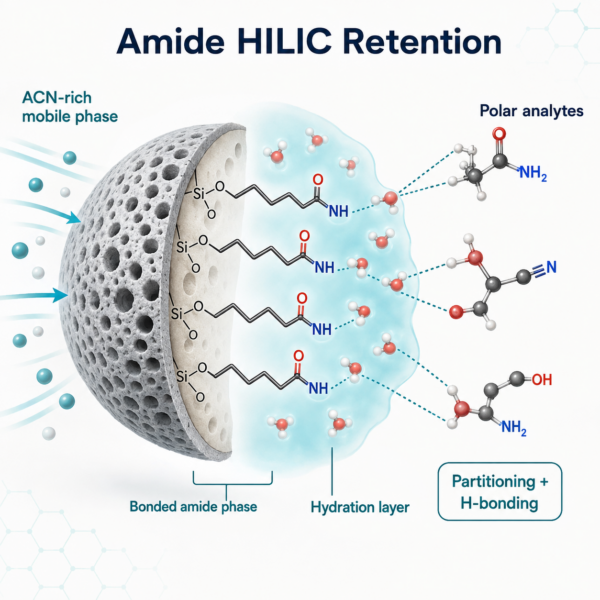
HILIC — Hydrophilic Interaction Liquid Chromatography — uses a polar stationary phase with a high-organic mobile phase (typically 5–40% water in acetonitrile). A thin, water-enriched layer forms on the polar surface, and analytes partition into it according to their hydrophilicity [1]. The more polar the metabolite, the stronger it is retained — the exact opposite of reversed-phase.
Partitioning is not the whole story: hydrogen bonding, direct surface adsorption and electrostatic interaction all contribute, and which one dominates depends on the analyte and the phase [1]. Our article on how HILIC retention works breaks the mechanisms down individually.
For polar-metabolite work, HILIC brings three big advantages:
- Genuine retention and separation of compounds that RP cannot hold.
- Better MS sensitivity, because the high organic content improves electrospray ionisation efficiency.
- No ion-pairing reagents needed, keeping your system and mass spectrometer clean.
The trade-off is that HILIC methods need longer equilibration and are more sensitive to sample solvent and buffer conditions — see our mobile phase basics guide for the fundamentals of buffers and organic modifiers, and the HILIC method development guide for concrete starting gradients.
The main HILIC stationary-phase chemistries
HILIC is not a single material but a family of surface chemistries, each with different selectivity:
- Zwitterionic (sulfobetaine) — carries both a positive and a negative charge in a 1:1 balance. Extremely versatile and the most popular choice for untargeted polar metabolomics.
- Amide — a neutral polar surface, robust and widely used, with strong retention for sugars and many metabolites.
- Bare silica — the simplest HILIC surface, relies on surface silanols and adsorbed water.
- Amino (NH2) — strong retention for acidic and sugar compounds, though less stable.
For a broad, untargeted polar-metabolite panel, zwitterionic and amide phases are the usual starting points. Be aware that columns sold under the same label are not equivalent: a 2025 characterisation of five nominally zwitterionic HILIC columns found large differences in their residual cation-exchange character, and one column showed none at all while still being the most retentive of the set [2].
A column guide: concrete options by manufacturer
Below are specific, commercially available HILIC columns widely used for polar metabolites. Each links to the manufacturer’s page (external links open in a new tab). The right choice depends on your analyte classes, your MS method and any established protocols you need to match — but these are all well-documented, defensible starting points.
Zwitterionic phases
- Merck SeQuant ZIC-HILIC / ZIC-pHILIC. A benchmark zwitterionic phase for polar metabolomics. ZIC-HILIC (silica-based) offers high, reproducible retention; ZIC-pHILIC (polymeric) extends the usable pH range and is a favourite for untargeted central-metabolism panels. ZIC-cHILIC provides complementary selectivity. The manufacturer guides specify 5–20 mM volatile buffer, at least 3% water and a sample solvent at 60–100% organic [3][4].
- Agilent InfinityLab Poroshell 120 HILIC-Z. A zwitterionic superficially-porous (core-shell) phase designed for reproducible retention of polar and acidic metabolites across multi-day studies. Agilent treats pH, buffer concentration and phase chemistry as the main selectivity variables and notes that equilibration may require 20–50 column volumes [5].
Amide phases
- Waters ACQUITY (Premier) BEH Amide. A robust hybrid-silica amide phase and one of the most widely cited HILIC columns in metabolomics. The Premier version adds MaxPeak surface technology to reduce metal-analyte interactions — valuable for phosphorylated and carboxylic-acid metabolites that otherwise adsorb to metal surfaces [6].
Core-shell for speed
- Phenomenex Kinetex HILIC. A core-shell HILIC phase giving high efficiency at more moderate back-pressures — a good middle ground when you want sharper peaks without a full UHPLC pressure budget. Phenomenex recommends roughly 10–30 column volumes for equilibration [7].
These are starting points, not the only valid choices — many excellent HILIC columns exist. The underlying selection logic is what matters, and it mirrors the general principles in our guide on how to choose the right HPLC column.
Practical tips for polar-metabolite HILIC
- Match the sample solvent to the mobile phase. Inject in a high-organic solvent similar to your starting conditions. A too-aqueous injection solvent is the classic cause of distorted or split early peaks in HILIC [3].
- Allow generous equilibration. HILIC columns need far more equilibration than RP, especially after gradients — manufacturer figures range from about 8 to 50 column volumes depending on the material [5][6][7]. Rushing this is a leading cause of drifting retention times.
- Use volatile buffers for MS. Ammonium formate or ammonium acetate at controlled pH give stable retention and stay MS-compatible; avoid nonvolatile phosphate [3].
- Mind metal-sensitive analytes. Phosphorylated compounds and organic acids can adsorb to metal surfaces, causing tailing and low recovery — inert hardware or a trace chelator addresses this [8].
- Control temperature. Stable column temperature keeps HILIC retention reproducible from run to run.
Key takeaways
- Polar metabolites are poorly retained on reversed-phase and need HILIC (or an orthogonal approach).
- HILIC retains polar compounds on a polar surface with a high-organic mobile phase, and boosts MS sensitivity.
- Zwitterionic (e.g. Merck ZIC-HILIC/pHILIC, Agilent HILIC-Z) and amide (e.g. Waters BEH Amide) phases are the standard starting points — but nominally similar phases are not interchangeable.
- Success depends as much on sample solvent, equilibration and buffer choice as on the column itself.
Many labs run RP and HILIC as complementary methods to cover the widest possible range of metabolites — the two together see far more of the metabolome than either alone.
References
- Guo Y, Muscatiello D. An update on the progress in fundamental understanding of hydrophilic interaction liquid chromatography. Journal of Chromatography A. 2026;1765:466520. doi:10.1016/j.chroma.2025.466520
- Vosáhlová Z, Poláchová J, Svoboda J, Kohout M, Kalíková K. Interaction properties and separation potential of zwitterionic stationary phases in HILIC. Journal of Chromatography Open. 2025;8. Open-access article
- SeQuant ZIC-HILIC user guide — buffer range, minimum water content, sample solvent and equilibration. Merck. sigmaaldrich.com (PDF)
- SeQuant ZIC-pHILIC user guide — extended pH range of the polymeric phase. Merck. sigmaaldrich.com (PDF)
- HILIC method development technical overview — pH and buffer concentration as selectivity variables; equilibration of 20–50 column volumes. Agilent. agilent.com (PDF)
- ACQUITY UPLC Glycan BEH Amide columns care and use manual — conditioning and re-equilibration requirements for amide phases. Waters. waters.com (PDF)
- Column care and use guide — equilibration volumes and HILIC storage conditions. Phenomenex. phenomenex.com (PDF)
- Birdsall RE, Kellett J, Yu YQ, Chen W. Application of mobile phase additives to reduce metal-ion mediated adsorption of non-phosphorylated peptides in RPLC/MS-based assays. Journal of Chromatography B. 2019;1126–1127:121773. doi:10.1016/j.jchromb.2019.121773
Leave a Reply