The column is where the actual separation happens in HPLC — it is the single most important consumable in your system. Choose the wrong one and even a perfectly good instrument will give you poor, overlapping or unreliable results. For a beginner, the sheer number of column options can be overwhelming. This guide walks through the main decisions in plain language, so you know what to look for.
What a column actually is
An HPLC column is a stainless steel (or sometimes PEEK) tube packed with a fine solid material — the stationary phase. As your sample travels through, different compounds interact with this packing to different degrees, which is what separates them. Choosing a column really means choosing the right packing material and the right physical dimensions for your job.
The three big choices
When selecting a column, you are mainly deciding on three things: the stationary phase chemistry, the particle size, and the dimensions (length and internal diameter). Let’s take them one at a time.
1. Stationary phase chemistry
This is the most important choice, because it determines how your compounds interact with the column. The guiding principle is to match the polarity: reversed-phase materials such as C18 suit non-polar to moderately polar compounds, while very polar compounds often need HILIC or a polar phase instead. The seven phases below cover almost everything you will meet in a routine laboratory.
C18 (ODS)

A long non-polar chain bonded to silica. This is the workhorse of reversed-phase HPLC and handles the majority of everyday samples. Retention comes from hydrophobic interaction: the less polar the compound, the longer it stays on the column. If you are unsure where to start, C18 is almost always the safe first choice.
C8

A shorter chain than C18, giving slightly less retention. It is the natural alternative when compounds stick too strongly to C18 and elute late or not at all, and it often shortens run times without changing the separation mechanism.
Phenyl-Hexyl

An aromatic ring held away from the surface by a short alkyl spacer. Alongside the usual hydrophobic retention it offers π–π interaction with aromatic analytes, which frequently changes the elution order compared with C18. This is the first phase to try when two compounds coelute on C18 and no amount of gradient tuning separates them.
Cyano (CN)

A moderately polar nitrile group. Cyano columns retain less than C18 in reversed-phase mode and are useful for moderately polar compounds. Their unusual feature is flexibility: the same column can be run in normal-phase mode with an organic mobile phase, which few other phases allow.
Amino (NH2)

A polar, weakly basic aminopropyl surface. It is the classic phase for carbohydrate analysis and can also be used in HILIC mode for polar compounds. Two practical cautions: amino phases are chemically less stable than alkyl phases, and they can react with reducing sugars and aldehydes over time.
HILIC

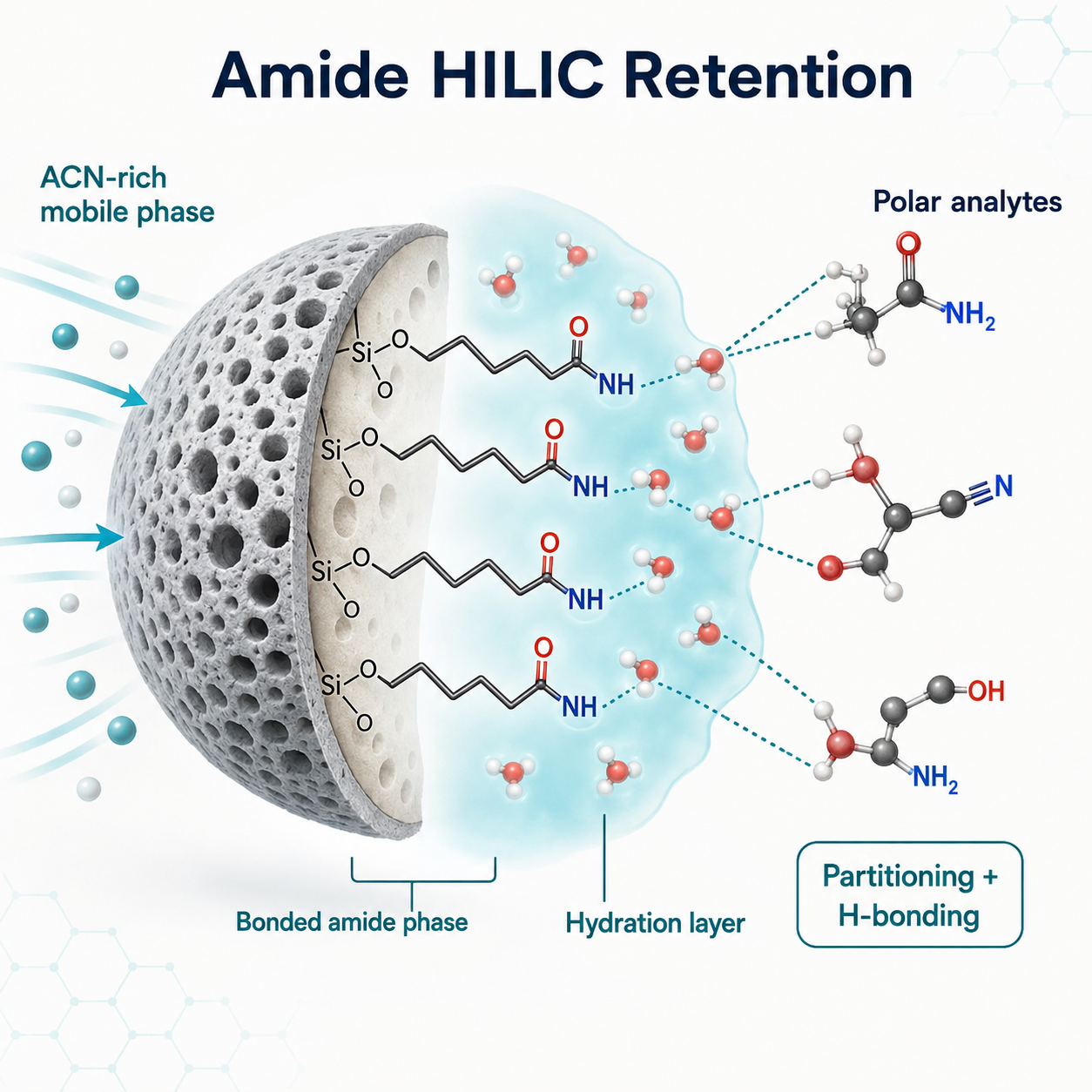
Designed for very polar compounds that a C18 barely retains — it works in an almost “reversed” way to standard reversed-phase, with a high proportion of acetonitrile and a water-rich layer at the surface into which polar analytes partition. Elution order is roughly the opposite of reversed phase.
HILIC has its own rules for equilibration, buffers and injection solvent. Our guides on how HILIC retention works and how to develop a HILIC method cover both in detail.
Bare silica

The unmodified support itself, with free silanol groups at the surface. Silica is used in normal-phase chromatography and, increasingly, as a HILIC phase. Because those silanols can carry a negative charge depending on pH, basic compounds may be retained by ion exchange as well — a source of extra selectivity, but also of peak tailing if pH and buffer are not controlled.
2. Particle size
The size of the packing particles affects both separation quality and the pressure your system needs to generate.
- 5 µm — traditional, robust and forgiving. A great default for standard HPLC and for beginners.
- 3 µm — sharper peaks and better resolution, at the cost of higher pressure.
- Sub-2 µm — used in UHPLC for the fastest, sharpest separations, but requires a high-pressure system.
There are also core-shell (superficially porous) particles, which give near-UHPLC performance at more moderate pressures — a popular middle ground.
3. Column dimensions
Two numbers describe the physical size of a column: its length and its internal diameter (ID).
- Length (e.g. 50, 100, 150 mm). Longer columns generally give better separation but take more time and create more back-pressure. Shorter columns are faster.
- Internal diameter (e.g. 2.1, 3.0, 4.6 mm). A standard analytical ID is 4.6 mm. Narrower columns (like 2.1 mm) use less solvent and pair well with mass spectrometry, but require lower flow rates.
A very common, general-purpose starting configuration is a 150 × 4.6 mm, 5 µm C18 column — if you have no other information, this is a sensible default to build from.
Don’t forget the guard column
A guard column is a short, cheap cartridge that sits in front of your main (analytical) column. It traps particulate matter and strongly binding junk from your samples, protecting the expensive main column from contamination. Replacing a guard column costs very little; replacing an analytical column costs a lot. For any real-world sample, using a guard column is one of the easiest ways to extend column life.
Practical tips for beginners
- Start with C18. Unless you have a specific reason not to, it is the most versatile phase.
- Change the phase, not just the gradient. If two peaks refuse to separate on C18, a phenyl-hexyl or cyano column will often solve in one run what hours of gradient tuning cannot.
- Check the method first. If you are following an established or published method, use the exact column type it specifies — column choice is part of the method.
- Keep a log. Note which columns work for which samples. Over time this becomes a valuable reference.
- Mind the compatibility. Check the column’s pH range and pressure rating against your mobile phase and instrument.
Key takeaways
- The column is where separation happens — choosing it well is critical.
- The main decisions are stationary phase chemistry, particle size and dimensions.
- C18 is the versatile default; match column polarity to your compounds.
- C8, phenyl-hexyl and cyano are the usual next steps when C18 retains too strongly or fails to resolve a critical pair.
- HILIC, amino and bare silica are the options for very polar compounds that reversed phase cannot hold.
- Smaller particles give sharper peaks but need higher pressure.
- A guard column is a cheap, easy way to protect your investment.
When in doubt, start simple, follow the method if you have one, and change only one variable at a time as you optimise.
Leave a Reply