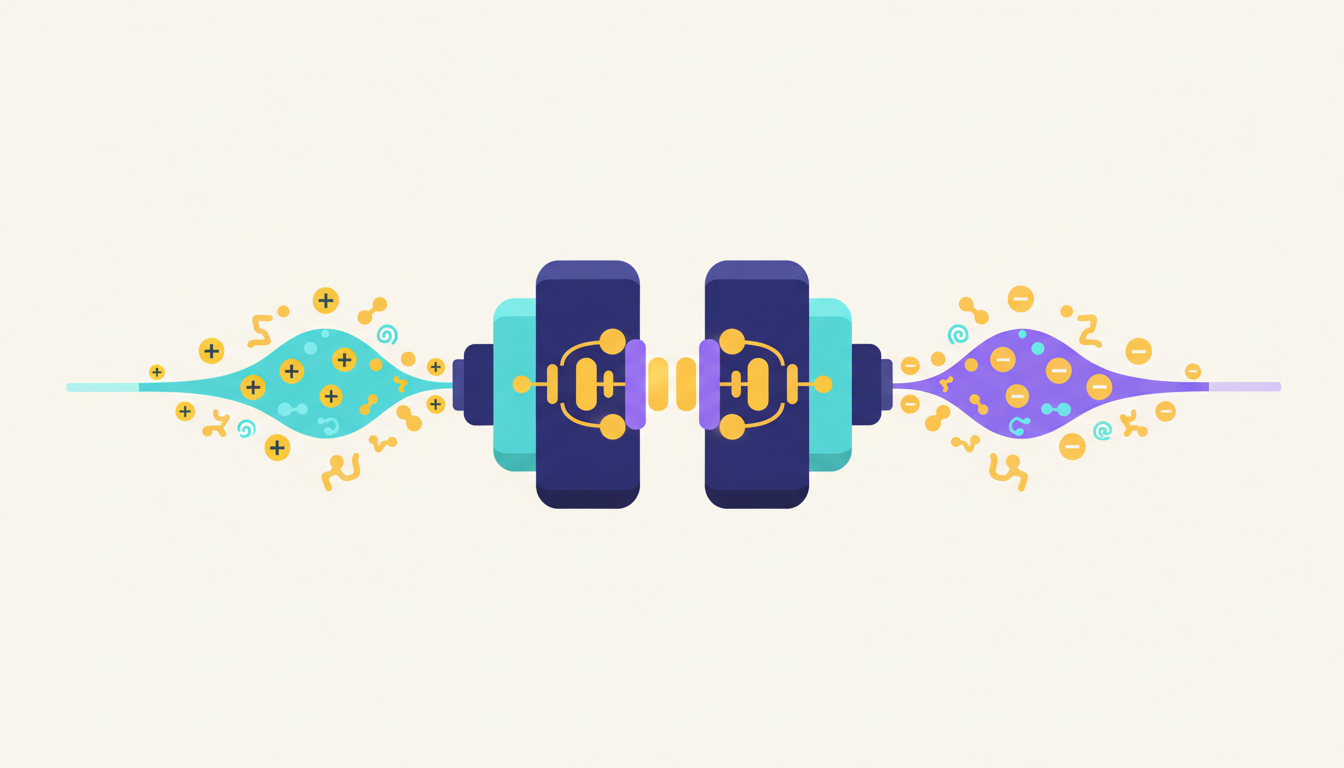
Beginner-friendly visual lesson: Positive and negative ESI ionization explained visually: protonation and deprotonation, example ions, mobile-phase chemistry, polarity switching and a quiz.

Follow the picture in four steps
| 🔵 Step 1
Read the molecule’s acidic or basic groups |
🟣 Step 2
Test formation of positive or negative ions |
🟡 Step 3
Compare response and fragments in both modes |
🟢 Step 4
Select a robust mode for the actual matrix |
Think of an electrical ‘plus’ and ‘minus’ view
A mass spectrometer normally detects ions. But some molecules are easier to measure when they carry a positive charge, and others when they carry a negative charge. Electrospray ionization (ESI) can be operated in either polarity to generate and sample the appropriate ions.
Positive mode: often good for bases
Compounds with protonatable functional groups—many amines, for example—often form ions such as [M+H]+. Other ions, including [M+Na]+ and [M+NH4]+, may also appear. A positive-mode precursor does not guarantee that the underlying compound is always positively charged in the liquid solution.
Negative mode: often useful for acids
Many carboxylic acids and other suitable acidic compounds can lose a proton to form [M−H]−. Certain molecules may instead produce formate adducts, chloride adducts or other species. Negative mode is not limited to acids, and pH/solvent effects are more complicated than a single rule.
A miniature comparison
| Question | Positive ESI | Negative ESI |
|---|---|---|
| Common observed ion | [M+H]+ | [M−H]− |
| Useful first test | Protonatable basic group? | Deprotonatable acidic group? |
| Signal drivers | Adduct chemistry and source conditions | Deprotonation, clusters and source conditions |
Example: a simple acid versus a simple amine
In a controlled comparison, an acid with a readily lost proton may give a stronger deprotonated-ion signal in negative ESI. An amine may produce a strong protonated signal in positive ESI. These are starting hypotheses rather than guaranteed results: sample composition, additives and interface settings can reverse expectations.
Five steps for a beginner method
- Draw or look up a trustworthy structure and identify ionizable groups.
- Calculate possible precursor m/z values for common ion species.
- Acquire full-scan or targeted test data in both polarities if the instrument and sample permit.
- Check actual peak shape, background, isotope pattern and fragments.
- Choose the mode giving adequate selectivity, sensitivity and reproducibility, not merely the highest one-time signal.
What if the method switches polarity?
Some instruments can rapidly alternate positive and negative mode. Switching consumes time and can reduce measurements across narrow peaks, especially in complicated MRM methods. Check the acquisition cycle time before combining both modes.
Related: Acids and Bases in HPLC.
Quick student quiz
- What is a common positive ion from a basic analyte?
- What is a common negative ion from an acid?
- Should ionization mode be chosen using structure alone?
Reveal the answers
- [M+H]+
- [M−H]−
- No; experimental response and selectivity must be tested.
Further reading
All figures and worked examples are educational illustrations, not substitute measurements for a validated laboratory procedure.